


Choosing the right floor isn’t just about colour, grain or texture — how the floor is installed
plays a huge role in performance, feel, durability, and long-term value. At The Carpet Stop, we
want you to make an informed choice, whether you’re investing in engineered wood, solid wood,
laminate, or luxury vinyl flooring.
In this guide we’ll break down the structural differences between floating, glued, and nailed
flooring systems, compare installation methods, look at real-world pros and cons, and help
you choose the best option for your home renovation or flooring upgrade project.
What Is Floor Installation & Why It Matters
“Flooring installation method” refers to how your floorboards are fixed to the subfloor or
each other. The method you choose impacts:
- Stability and movement
- Sound and acoustic performance
- Suitability for different floor materials
- Ease of repair
- Cost of installation
- How long the floor lasts
Let’s explore the structural mechanics behind each installation type.
1. Floating Floor Installation — Quick, Flexible &
DIY-Friendly
How Floating Floors Work
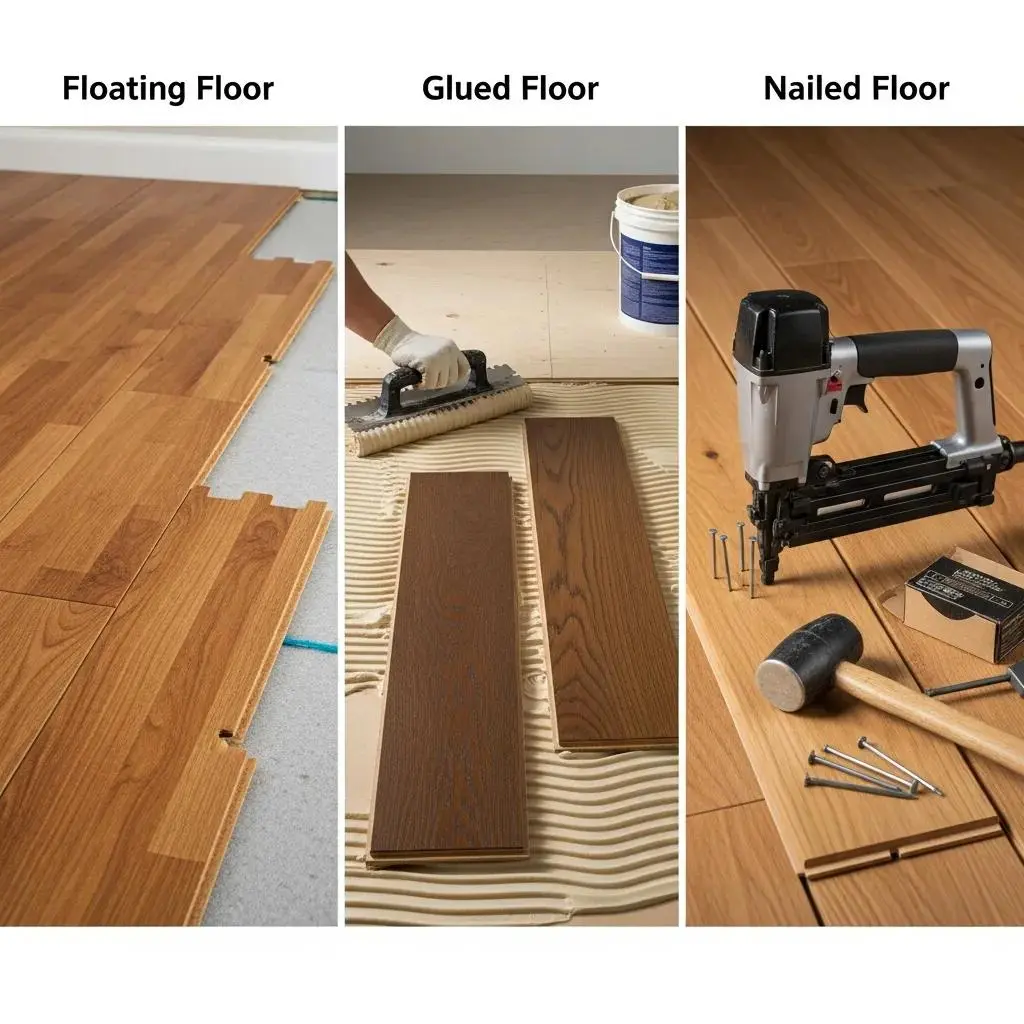
A floating floor isn’t attached to the subfloor at all. Instead, planks or tiles click and interlockwith one another and simply “float” over an underlayment. This structure creates a securesurface without glue or nails.
- Boards are joined together via click-lock or tongue-and-groove systems.
- They rest on an underlay for insulation, moisture protection, and sound absorption.
- The floor expands and contracts as a whole unit when humidity and temperature change
— which is normal for wood flooring.Materials Commonly Used with Floating Floors
- Laminate
- Engineered wood
- Luxury Vinyl Planks (LVP)
Floating installation is especially popular with products that are designed for quick installation and modern living.
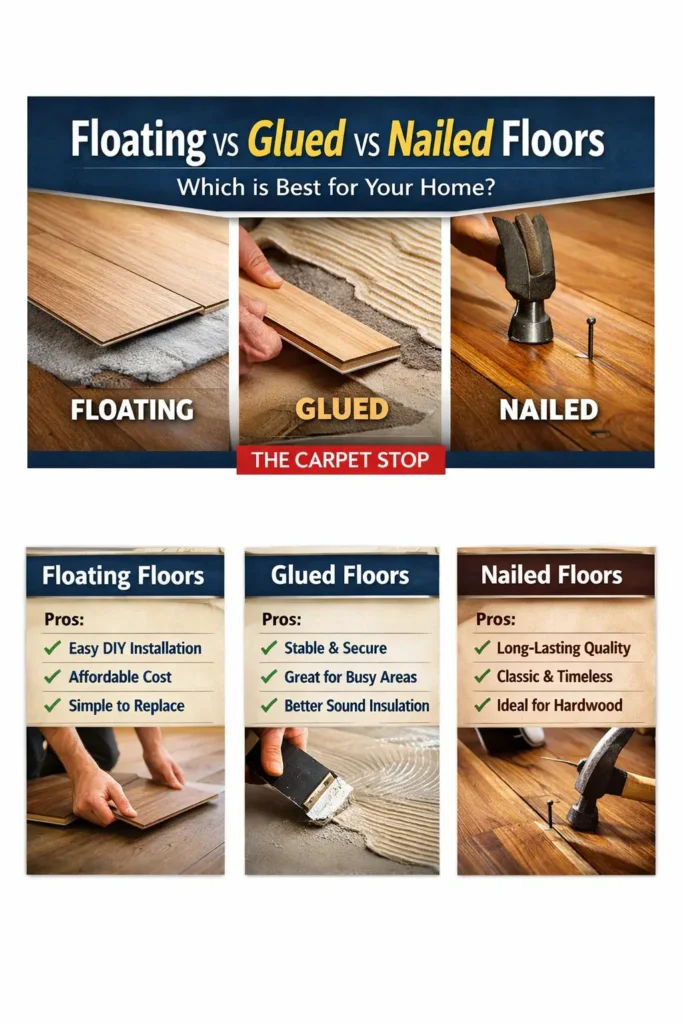
Pros of Floating Floors
✔ Faster installation – often completed in a single day compared to glued or nailed floors.
✔ Lower cost – less labour and no adhesive or specialist tools needed.
✔ DIY-friendly – with modern click systems, handy homeowners can install themselves.
✔ Easy to replace and repair – individual planks can be swapped without tearing up the whole floor.
✔ Versatile over various subfloors – works over concrete, plywood, or existing flooring (with proper preparation).Cons of Floating Floors
✘ Slight movement or sound – may feel less solid underfoot than glued or nailed methods.
✘ Subtle movement over time – boards may shift slightly as they expand/contract.
✘ Not ideal for all moisture-prone areas unless moisture barriers are used.
2. Glued-Down Floor Installation — Stable & Permanent
How Glued Floors Work
Glue-down installation uses a strong adhesive to bond each plank or tile firmly to the subfloor — typically concrete or prepared plywood. This method creates a very stable and secure surface.
It’s especially common with:
- Engineered hardwood
- Some vinyl products / LVP
- Parquet flooring patterns (like herringbone) where precision is key
Pros of Glued Floors
✔ Firm underfoot feel – less movement than floating floors.
✔ Better acoustic performance – adhesive reduces hollow sounds and vibration.
✔ Good stability in busy homes – ideal for living rooms, hallways, and heavy traffic areas.
✔ Great for moisture-controlled areas – when moisture barriers are used with glue, it can be suitable for kitchens or utility rooms.
Cons of Glued Floors
✘ More labour-intensive installation – requires expert precision and careful adhesive application.
✘ Longer project time – waiting for adhesives to cure adds time.
✘ Harder to repair – removing a damaged plank without affecting adjoining boards can be tricky.
3. Nailed Floors — The Traditional & Timeless Method
How Nailed Floors Work
Nail-down installation involves hammering boards directly into a wooden subfloor with nails or staples, creating a permanent bond. Historically most common with solid hardwood floors, this method offers unmatched longevity.
Best Materials for Nailed Floors
- Solid hardwood flooring
Engineered wood with suitable tongue-and-groove design
Pros of Nailed Floors
✔ Longest lifespan – with sanding and refinishing, nailed solid wood floors can last decades.
✔ High-end look and feel – timeless quality often favoured in premium properties.
✔ Excellent underfoot stability – rigid mechanical fixing prevents shifting or movement.
Cons of Nailed Floors
✘ Expensive installation – requires specialist fitters and precision tools.
✘ Limited to wood subfloors – not suitable for concrete or floors that can’t accept nails.
✘ Time-consuming – the process is slower than floating methods.
Floating vs Glued vs Nailed Floors: Side-by-Side Comparison
Feature |
Floating |
Glued |
Nailed |
Ease of Installation |
★★★★☆ |
★★☆☆☆ |
★☆☆☆☆ |
Cost of Installation |
Low |
Medium |
High |
DIY-Friendly |
Yes |
Limited |
No |
Stability |
Moderate |
High |
Highest |
Repairability |
Easy |
Difficult |
Moderate |
Moisture Suitability |
Moderate |
Moderate-High |
Low |
Typical Materials |
Laminate / LVP / Engineered |
Engineered / Vinyl |
Solid / Engineered |
(Based on industry installation norms) |
Which Installation Method Is Best for You?
Choosing the right installation method depends on budget, material type, subfloor, lifestyle, and long-term plans.
? Choose Floating Floors If:
- You want quick installation and lower cost.
- You’re a DIY enthusiast or planning a home upgrade yourself.
- You want easy future replacement or flexibility.
- You have a solid, flat subfloor but aren’t sure about moisture levels.
This method pairs perfectly with laminate and many engineered wood products that click together easily.
? Choose Glued Floors If:
- You prioritise stability and long-term performance.
- You have concrete or non-wood subfloor that needs bonding.
- You want a smoother, quieter feel underfoot.
This is a great choice for engineered wood and luxury vinyl plank flooring in main living spaces.
? Choose Nailed Floors If:
- You’re installing solid hardwood for longevity and resale value.
- You want a floor that can be sanded and refinished multiple times.
- You’re renovating a premium property where quality and permanence matter most.
This classic method suits traditional homes and high-end flooring projects.
Installation Costs & Longevity Explained
As a rule of thumb:
-
Floating floors are generally cheapest and quickest to install.
-
Glued floors cost more due to adhesives and preparation.
-
Nailed floors tend to be the most expensive and labour-intensive.
Longevity varies too:
- Floating floors: 10–30 years
- Glued floors: 20–30 years
- Nailed solid wood: 30–100+ years with proper care
Tips for Flooring Success
✅ Always test moisture and level your subfloor.
✅ Follow manufacturer installation guidelines.
✅ Use the right underlay or adhesive for the product you choose.
✅ Consider professional installation for glued or nailed floors for best results.
Final Thoughts
There’s no single “best” method — only the one that fits your project goals, materials, and lifestyle. Whether you’re choosing floating floors for quick living-space makeovers, glue-down installation for long-lasting stability, or nail-down hardwood for timeless quality, understanding the structural differences empowers you to make the best decision.
At The Carpet Stop, we’re here to help every step of the way — from selecting products to understanding installation choices and getting the best value from your flooring investment.