


If you’ve got two (or even three!) kids sharing one bedroom, you already know the challenge: different personalities, different routines, double the stuff — all inside one space that still needs to feel calm at bedtime.
That’s exactly why we’re excited to share some practical inspiration alongside a bit of news from our family of brands: The Carpet Stop has officially expanded into beds with the launch of The Bedstop. Same commitment to value and service — now with bedroom furniture designed to help UK homes make the most of every inch.
In this guide, we’ll walk through how to plan a shared kids’ room that feels fair, functional, and fun — and we’ll finish with one of the best space-saving upgrades you can make: an ottoman bed, which hides a surprisingly large storage area under the mattress. (Perfect for shared rooms where storage is always the bottleneck.)
Start with the non-negotiables (before you buy anything)
Before paint swatches and Pinterest boards, start with the basics. A shared room works best when it’s built around routines and boundaries, not just décor.
Talk it through with both kids (even little ones). Keep it simple:
- What do they like about sharing?
- What annoys them?
- What do they want to keep “just theirs”?
- Are bedtimes different?
- Do they need a quiet corner for reading or homework?
If there’s a bigger age gap, this matters even more. A teen’s needs (privacy, studying, downtime) are totally different to a toddler’s (play, early nights, toys everywhere).
Quick win: agree 2–3 “shared room rules” early on (e.g., no touching the other person’s drawers, quiet time after lights-out, toys away from the beds). It sounds basic, but it prevents 80% of the daily friction.

How to divide a bedroom in two (without building a wall)
You don’t need a renovation to make a shared bedroom feel fair. The goal is simple: each child should feel like they have ownership of part of the space, even if the room is small.
Option 1: Split the room into two clear zones
If the layout allows, divide the room visually:
- left side / right side
- window side / door side
- “sleep zone” + “play/study zone”
Even if the zones aren’t exactly equal in size, they can feel equal in function.
Option 2: Give each child a “personal corner”
If the room is tight, aim for one defined area each:
- a bedside shelf + wall space
- a desk corner
- a section of wardrobe + their own storage bins
That “this is mine” feeling is what reduces arguments.
Option 3: Use the bed choice to create space
Beds are the biggest item in the room — so they’re also your biggest opportunity.
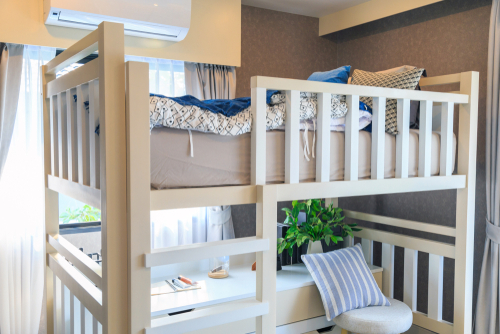
- Bunk beds free up floor space for desks and play.
- Mid sleepers / high sleepers can add built-in desks or play space underneath.
Storage beds reduce the need for extra drawers and bulky furniture. Safety note (important): many retailers and safety guides recommend children under 6 do not sleep on the top bunk, and to follow guard rail, mattress depth, and assembly guidance carefully.
Decorating for different tastes (without turning it into a battle)
No two kids like the same things — and trying to mash two themes together (dinosaurs + princesses + Minecraft) can quickly look… loud.
Here are three approaches that keep everyone happy:
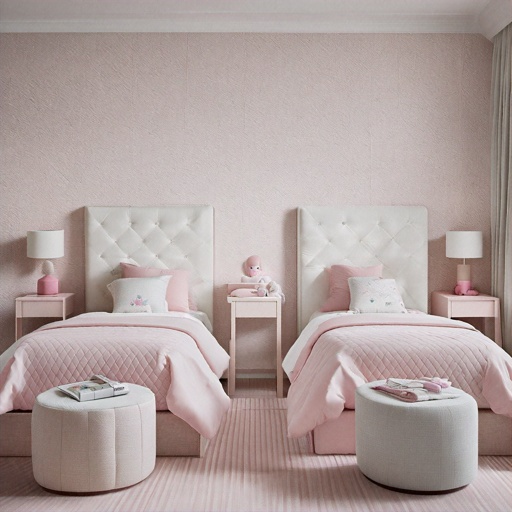
1) Keep the base neutral, personalise the details
A calm base (soft white, warm beige, light grey) gives you flexibility — and stops you having to redecorate every time tastes change.
Then layer personality through:
- bedding
- cushions
- posters
- storage boxes
- rugs
Peel-and-stick wallpaper can be a great compromise: it’s easier to update, and you can use it in small “feature” areas rather than the whole room.
2) Try a playful “eclectic” look that allows variety
A more colourful, mix-and-match style can actually work brilliantly in shared rooms because it makes “different” feel intentional.
If one child likes bold colour and the other likes softer tones, you can unify the space with:
- a consistent wood finish (e.g., white furniture)
- one shared accent colour
- matching frames for wall art
Trend-based inspiration changes fast, but shared-room searches and room-divider ideas have been rising on Pinterest in recent years, which reflects how common shared bedrooms have become.
3) Create “matching but different”
One of the simplest ways to make it look cohesive:
- same bed style, different bedding
- same curtains, different cushions
- same storage unit, different coloured baskets
It looks styled, but both kids still feel represented.
Let each child personalise their space (cheaply)
Personalisation doesn’t have to mean expensive furniture.
Easy, high-impact ideas:
- their name or initial on the wall (wood, acrylic, or fabric banners)
- a pinboard or magnetic board each
- a small shelf each for “pride” items (LEGO builds, trophies, favourite books)
- their own bedding choice
When kids can choose something that feels like theirs, they tend to respect the space more — and they’re less likely to feel like they’re “borrowing” someone else’s room.
Storage: the difference between calm and chaos
In shared rooms, the biggest problem is almost never the beds — it’s the stuff.
Here’s a practical storage stack that works:
1) Give each child clearly labelled storage
Do this first. Even if it’s just two baskets and two drawers:
- colour-code it
- label it
- make it obvious
2) Use vertical space
Floating shelves, tall bookcases, and wall hooks are your best friends when floor space is limited.
3) Choose furniture that “earns its footprint”
Instead of adding more furniture to store things… pick furniture that stores things.
Examples:
- bookcase headboards
- beds with drawers
- mid sleepers with integrated storage
ottoman beds (more on this below)
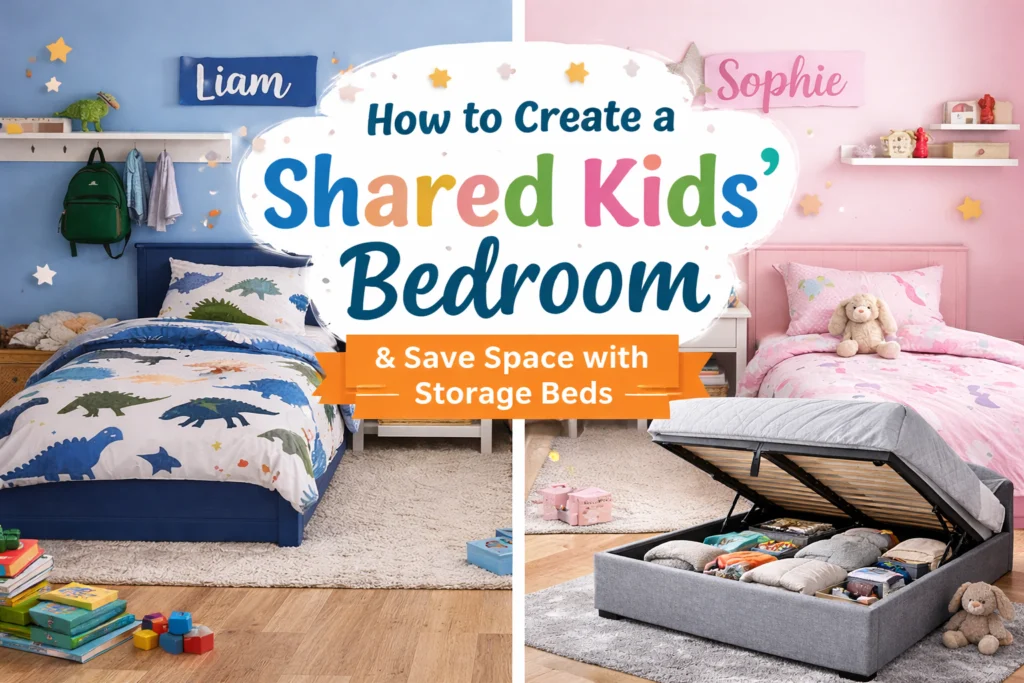
Why ottoman beds are a game-changer in shared kids’ rooms
If you’re short on space, an ottoman bed can feel like you’ve added an extra cupboard to the bedroom — without taking up any extra floor area.
What is an ottoman bed?
An ottoman bed uses a lift-up base (often with gas-lift hydraulics) so you can access a large storage compartment underneath the mattress. Unlike drawer beds, ottoman storage typically uses almost the full footprint of the bed, making it one of the biggest storage options you can get in the same space.
They can open:
- from the foot end, or
- from the side (useful if the bed is against a wall).
How ottoman beds help in shared bedrooms
They’re especially useful when you want to reduce clutter without adding more furniture. In a shared room, that usually means:
- spare bedding
- winter clothes
- toys that rotate (less out at once = less mess)
- school bags and sports kit
- keepsake boxes (birthday cards, crafts, etc.)
Because everything stores inside the bed, the room looks tidier — and it’s easier to keep it that way.
Ottoman bed tips for families
- Use storage bags or fabric boxes inside to keep it organised (one side each works well for siblings).
- Store bulky but lightweight items for kids (duvets, soft toys, seasonal clothing).
- Check the manufacturer guidance for mattress compatibility and weight limits (some very heavy mattresses may not be suitable for certain lift mechanisms).
- If your child will open it themselves, consider a model with a smooth, controlled lift and teach “lift safely, close slowly”.
The Bedstop takeaway: if you want the room to feel bigger without changing the room, a single ottoman bed is one of the most effective upgrades you can make — especially in smaller UK bedrooms.
Lighting that avoids bedtime arguments
Shared rooms often hit one predictable issue: one child wants lights out, the other wants to read.
Instead of making the main light the battleground, give each child control:
- clip-on reading lights
- small bedside lamps
- warm, low-glare bulbs
- a soft nightlight (great for younger kids)
The aim is to make bedtime routines easier and reduce “stop moving / I can’t sleep!” complaints.
Build a shared activity space (so the bed isn’t the play area)
When two kids share, they need a shared “yes space” that isn’t on top of the bedding.
Depending on ages, that might be:
- a rug + toy baskets (great for younger kids)
- a small desk or craft table (LEGO, drawing, puzzles)
- a reading nook with beanbags
- a homework station (older kids)
If you can, keep the play/activity zone away from the beds — it helps bedtime feel calmer and keeps the sleeping area cleaner.
How long can children share a bedroom?
Realistically, children can share as long as your family needs — but it’s wise to plan for privacy as they grow.
Some UK guidance recommends that children over 10 should ideally have their own bedroom, while acknowledging this isn’t always possible. If sharing continues, regular check-ins and ensuring each child gets some private time can help.
On the housing/legal side, rules around statutory overcrowding can be relevant in certain contexts. For example, resources summarising the Housing Act 1985 “room standard” often note concerns where two people over 10 of opposite sexes (who aren’t a couple) have to sleep in the same room.
If you’re unsure, consider your children’s:
- comfort
- privacy needs
- sleep quality
- study demands (especially as exams approach)
The earlier you design the room with “growing up” in mind (flexible décor, adaptable storage), the less stressful future changes become.
Bringing it all together: a shared room checklist
If you want a quick blueprint, use this:
- Each child has their own storage space
- The room is visually divided (zones or corners)
- Beds free up space (bunks, sleepers, or storage beds)
- Personalisation is balanced (matching-but-different works best)
- Lighting supports different routines
- There’s a shared activity zone
- The storage plan can scale as they grow
Ready to upgrade the room? Meet The Bedstop
The launch of The Bedstop means you can now shop bedroom solutions from the same team behind The Carpet Stop — with a focus on practical, space-smart beds that make everyday family life easier.
If you’re building a shared kids’ room, the best place to start is the biggest space-saver:
- bunk beds for floor space
- mid sleepers for multi-use layouts
- single ottoman beds for hidden storage that replaces extra furniture